

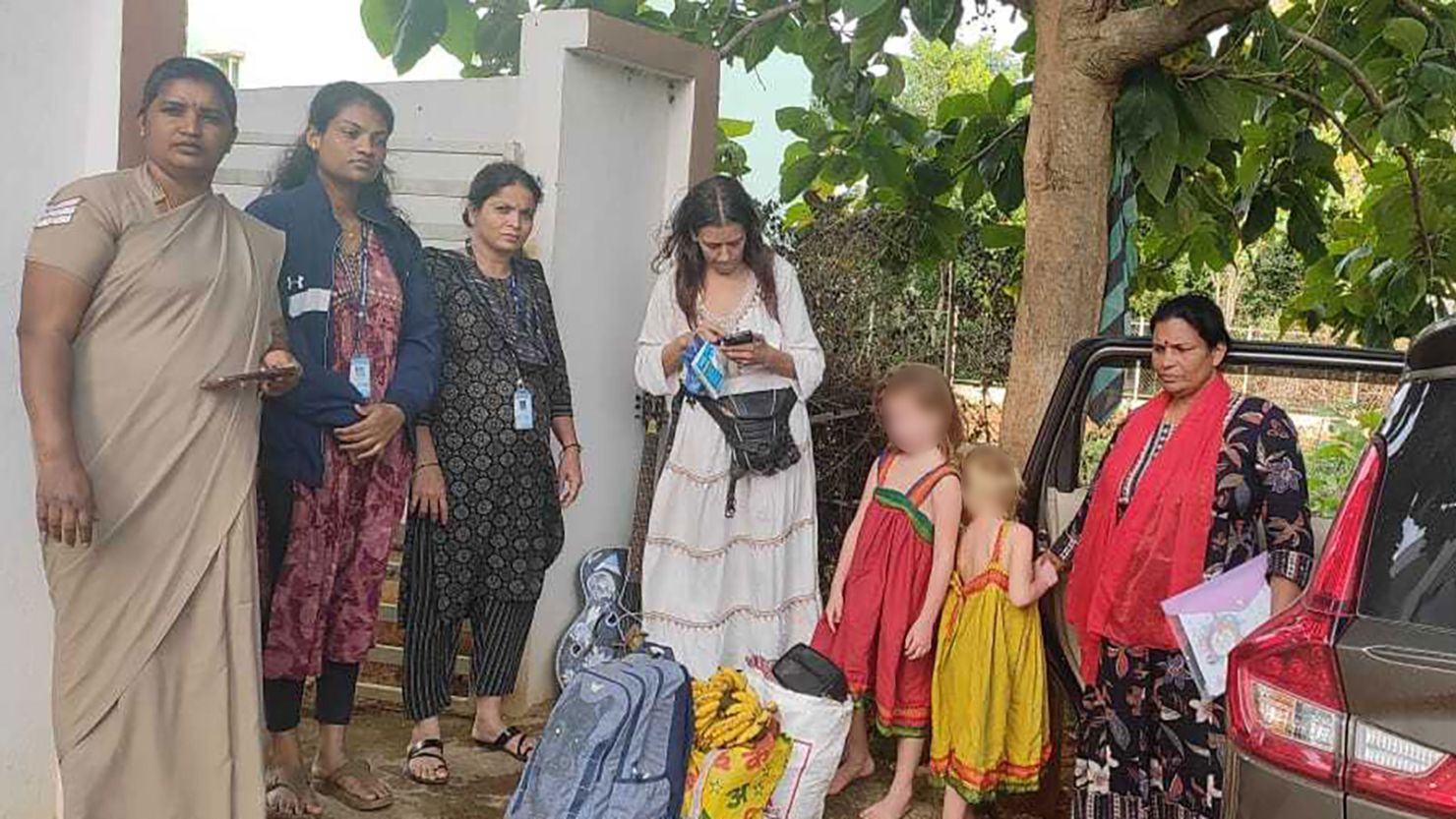
A remarkable and somewhat perplexing story has emerged from the verdant, rugged terrain of Karnataka, India, where police recently encountered a Russian woman, Nina Kutina, and her two young daughters living in an isolated cave. This discovery has ignited a quiet investigation to unravel the circumstances that led this family to such an unconventional existence in the wilderness bordering the popular tourist destination of Goa. The narrative is unfolding with a blend of curiosity and concern, as authorities attempt to piece together their journey and motivations.
The family’s presence was discovered during a standard police patrol around the Ramteertha hills, in the Gokarna forest. Officers, who regularly monitor the area to ensure tourist safety due to risks like landslides and the presence of wildlife, were taken aback to find colorful clothing drying near an isolated rock structure. Upon investigating further, they found a cave with its entrance subtly covered by colorful saris. As they got closer, a little blonde girl appeared and brought the officers to her mother, Nina Kutina, and her other child inside the shelter.
Within the cavern, law enforcement found a minimal yet apparently effective habitation setup. They noted plastic mats, some pieces of clothing, and various packs of instant noodles with other essential groceries as their limited belongings. Even though the condition was moist and their environment very basic, footage filmed by the authorities reveals the kids in vibrant Indian clothes, looking pleased and even posing happily for the camera. The image provided a notable contrast to the expected threats of the woodland area, recognized for its snakes and wildlife. Official reports mentioned that the mother and her children appeared surprisingly comfortable in their unconventional dwelling.
Convincing Nina Kutina to leave the cave proved to be a delicate process. When informed of the risks posed by the forest’s inhabitants, her response was both surprising and insightful: “Animals and snakes are our friends. Humans are dangerous.” This statement offered a glimpse into her unique worldview and her apparent comfort with nature over human society. Following their eventual removal from the cave, Ms. Kutina and her daughters, aged six and five, underwent medical examinations and were confirmed to be in good health.
The core of the mystery now revolves around Nina Kutina herself. Officials from India’s Foreigners Regional Registration Office (FRRO) have confirmed her Russian nationality and stated that preparations are underway for her repatriation, a process that involves coordination with the Russian consulate in Chennai. In interviews given to Indian news agencies, Ms. Kutina revealed that she had not resided in Russia for 15 years, having traveled extensively to numerous countries including Costa Rica, Malaysia, Bali, Thailand, Nepal, and Ukraine.
Her narrative, as related through these interviews, also reveals a sorrowful aspect: she is the mother of four children whose ages span from five to twenty years old. She conveyed the devastating news of her oldest son’s passing in a vehicular accident in Goa last year. Authorities have also mentioned that her second child, who is eleven, is presently in Russia, and they have communicated this detail to the consulate.
Adding another layer to this intricate narrative, the FRRO recently identified the father of the two girls found in the cave as Dror Goldstein, an Israeli businessman who is currently in India. Mr. Goldstein, who stated he had filed a missing person report when Ms. Kutina left Goa without informing him, has expressed his desire for joint custody of their daughters and has indicated his intention to prevent their deportation to Russia, emphasizing his commitment to their well-being. This development introduces a personal and legal dimension to the unfolding situation, highlighting the complexities of family ties across international borders.
The exact timeline of Nina Kutina’s arrival in the Karnataka forest and her stay in the cave remains somewhat obscure. She informed the police that she and her daughters had been living in the cave for a week, having previously resided in another cave in Goa, where she claimed one of her daughters was born. She also mentioned purchasing groceries, including instant noodles, from a local store a week prior to their discovery.
Her extensive travel record both within India and abroad is equally intricate. Although she claimed her passport was missing, an expired one discovered with her possessions indicated she entered India with a business visa active from October 2016 to April 2017. She remained in the country beyond the visa’s expiration, was detained a year later, and received an “exit permit” from the Goa FRRO. Immigration stamps reveal she traveled to Nepal in April 2018 and left three months afterward. It is unclear where she journeyed subsequently, although she mentioned having visited at least four other countries since her departure from India in 2018. She professes that she returned to India, possibly in February 2020, due to her strong fondness for the nation. Her current visa had expired several months before she was found, a situation she blamed on her mourning over her son’s passing.
The motivation behind her choice of dwelling has also been a subject of speculation. An idol of Panduranga Vittala, a form of the Hindu deity Krishna, was found in her cave, initially leading to reports that her presence was rooted in spiritual or meditative practices. However, Ms. Kutina has directly refuted this, stating, “It is not about spirituality. We just like nature because it gives us health… it’s very big health, it’s not like you live in a home.” She emphasized her extensive experience living in natural environments, even in jungles, and insisted that her daughters were happy and thriving there. She described their cave as “very big and beautiful,” conveniently located near a village for acquiring necessities.
She vigorously supported her choice, claiming that her kids were safe and thriving. She described their pursuits: swimming at a nearby waterfall, participating in art classes, crafting with clay, creating paintings, and savoring the delicious meals she prepared. She also minimized worries about encountering snakes, comparing their presence in the woods to discovering them in regular houses. Her emphasis on the wellness advantages and genuine happiness gained from residing in nature offers insight into her personal philosophy, indicating an intentional and informed decision rather than an act of despair.
The case of Nina Kutina and her daughters has become a focal point for discussions about alternative lifestyles, individual autonomy, and the role of authorities in managing such unique circumstances. It highlights the complexities of cultural and legal frameworks when individuals deliberately choose to live outside societal norms.
The authorities face the challenge of balancing the children’s well-being, the mother’s decisions, and the enforcement of immigration rules. As this story quietly unfolds, it captivates by showcasing the varied ways people search for purpose and joy in an ever more conventional society. The family’s future is still unclear, yet their extraordinary venture into the Indian wilderness has undoubtedly made a lasting impact on those who met them.


